REVIEW · BUCHAREST
Guided Walking Tour of Historical Bucharest
Book on Viator →Operated by Claires Bucharest Guided Tours · Bookable on Viator
If you like cities that show their scars, Bucharest is your place. This guided 3-hour historical walking route strings together old inns, Orthodox churches, grand squares, and the 1989 Revolution memorial area, with a local guide who brings the city’s past into focus as you walk.
What I like most is the way the route stitches together architecture and politics in plain, human terms, so you don’t just see buildings—you understand why they look the way they do. I also really like the structure: short stops with frequent photo moments at key squares, then a steady march through the older lanes and landmarks you’d miss if you just followed a map.
One thing to consider: you do need moderate walking stamina. It’s a lot of street time in about three hours, and the tour content leans into 20th-century political history, including Ceaușescu-era Romania and the Cold War.
In This Review
- Key Highlights You’ll Actually Feel on the Walk
- Starting at Manuc’s Inn: Halting the Clock in Bucharest’s Old Centre
- St Anton Orthodox Church and the Coronation Idea in the City’s Heart
- Old Princely Court Ruins and Vlad the Impaler’s Shadow
- Piata Unirii to Unirii Boulevard: The City’s Core, Rewritten in Stone and Fountains
- Piata Constituției and the Church of 1724: Another Political Layer, Another Time Period
- CEC Palace, Victoria Avenue Shops, and Passing from Big Statements to Everyday Streets
- The Old Centre Loop: 500 Years of Bucharest Through Passages
- University Square and Suţu Palace: Cuza’s University and an Old Residence Turned Museum
- Colțea Hospital and Church (1888), National Theatre, and Kretzulescu Church
- The 1989 Revolution Trail: Memorials, Ceaușescu’s Balcony, and the Monument of National Rebirth
- Military Circle and Sărindar Fountains: Ending With Garden Views and Old Prestige
- What This Tour Teaches You About Bucharest Under the Cold War
- Walking Smart for a 3-Hour Route (and Getting the Photos)
- Price and Value: What $30.77 Buys You in Bucharest
- Should You Book the Guided Walking Tour of Historical Bucharest?
- FAQ
- How long is the Guided Walking Tour of Historical Bucharest?
- What does the tour cost?
- Is hotel pickup included?
- Is the tour in English?
- Do I need tickets for the stops?
- Can I get a refund if plans change?
Key Highlights You’ll Actually Feel on the Walk
- Manuc’s Inn (Hanul lui Manuc) as a smart starting point in the Old Centre, where Bucharest storytelling begins early
- Piata Unirii and Unirii fountains for big views and quick photo stops in the city’s core
- A front-row look at the Palace of Parliament from the boulevard approach, where scale does the talking
- A strong 1989 Revolution trail stop set, including the Memorial of Rebirth area and the Ceaușescu balcony mention
- Mix of major landmarks with quieter stops like passage Macca and Villacrosse and the National Bank frontage
Starting at Manuc’s Inn: Halting the Clock in Bucharest’s Old Centre
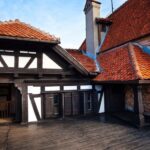
Your tour starts at Hanul lui Manuc (Manuc’s Inn), right in the Old Centre. Even if you’ve never heard of the place, the setting helps you shift gears fast: this is the kind of Bucharest landmark that feels like a meeting point, not just a monument.
A good chunk of the early value here is the storytelling angle. The inn is presented as the city’s oldest and most famous hospitality stop, and that matters because it sets a theme for the whole walk: Bucharest has always been a crossroads. As you move on, you’ll keep seeing the city as something built by layers of power, trade, and everyday life.
Practical note: since the tour ends back at the same point, it’s easy to plan the rest of your day right after the walk.
You can also read our reviews of more walking tours in Bucharest

St Anton Orthodox Church and the Coronation Idea in the City’s Heart
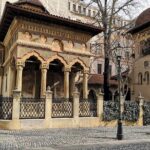
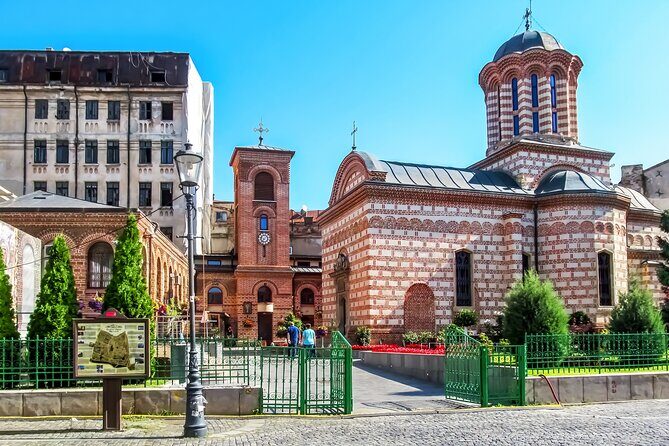
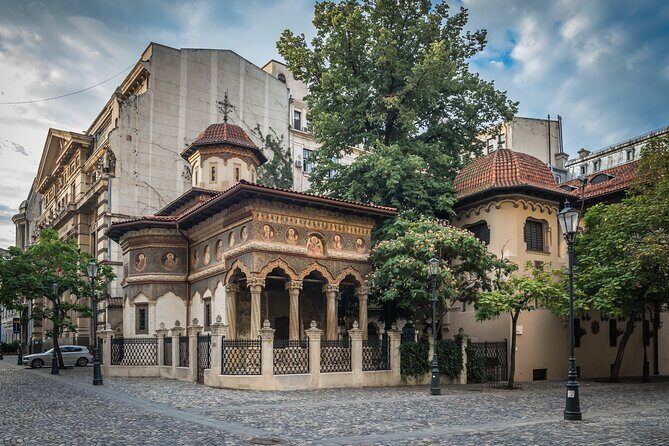
Next up is St Anton Orthodox Church. This isn’t framed as just another church stop. You’re shown its role as a former Coronation Church of Wallachian rulers, located right in the city’s working center.
Why you’ll care: coronation churches connect religion, authority, and public space. In other cities you might see that relationship in a museum. Here, you see it in the street-level location and feel how Central Bucharest became a stage for power.
It’s also the kind of stop that helps you understand the later shifts. When regimes change, the city doesn’t reset. It just repaints the same bones, and churches are one way those bones keep showing through.
Old Princely Court Ruins and Vlad the Impaler’s Shadow
At Old Princely Court, you’ll see the ruins of the Old Princely Palace tied to Wallachian rulers. The guide points out that this is one of Bucharest’s oldest buildings and, at one time, the residence connected with Vlad the Impaler.
The ruins make a difference. If you’re used to standing in perfectly preserved palaces, ruins can feel like a letdown. Here, they’re useful because they keep the story honest. Bucharest’s past isn’t all intact marble. Some of it is foundation-level traces, and that’s exactly why this stop works.
Admission is listed as free for this segment, so you don’t need to spend time searching for tickets or thinking about extra costs.
Piata Unirii to Unirii Boulevard: The City’s Core, Rewritten in Stone and Fountains
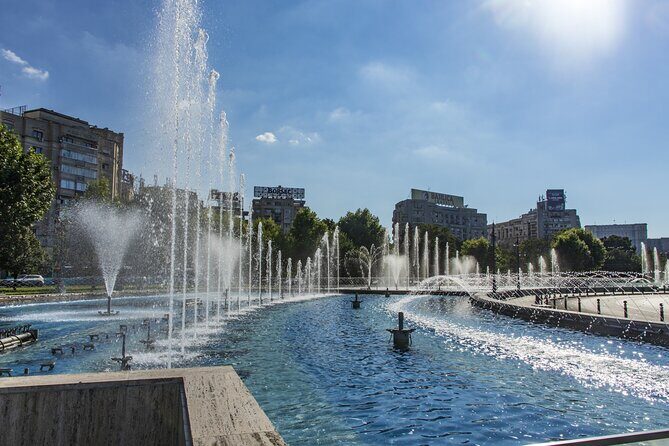
Then you hit Piaka Unirii (Piata Unirii) with its refurbished fountains and strong photo angles. This is where Bucharest’s “show your face” energy lives. It’s also one of the quickest ways to orient yourself because it’s positioned as the heart of the city.
From there, the tour moves to Bulevardul Unirii, described as the former Boulevard of Socialist Victory. You’re essentially walking the line between two Bucharest identities: the old civic core and the socialist-era power statement.
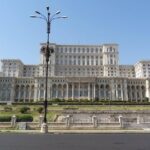
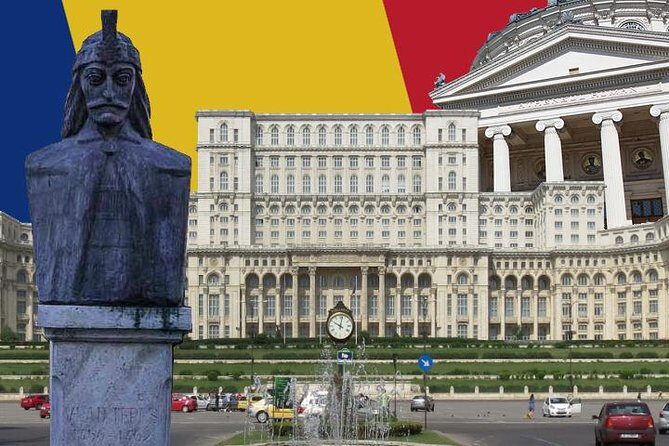
And then you approach the Palace of Parliament from the boulevard side. Even if you don’t know anything about it, you’ll feel the shift as the building dominates the scene. It’s one of those landmarks where your camera wants to keep working even after you’ve taken enough pictures. The guide also uses it to connect Bucharest’s recent history—Ceaușescu’s dictatorship and the Cold War—to what you see in front of you.
Photo tip: plan for waiting at the edge of the crowd lines. The best angles are usually near the open plaza spaces.
Piata Constituției and the Church of 1724: Another Political Layer, Another Time Period
You’ll step toward Piaka Constitukiei, a popular area directly in front of the parliament buildings with excellent photo opportunities. This stop is basically about location. You’re shown how this part of the city is organized around power, viewing corridors, and public monuments.
After that, you’ll encounter a church built in 1724 with a fascinating backstory. The important part for your planning is the tone shift. You’ve just spent time in large-scale state imagery. Then you move to an older religious landmark, which gives you a clearer timeline of what changed and what stayed.
If you’re the kind of person who enjoys “then and now” history, this is one of the more satisfying transitions on the route.
You can also read our reviews of more guided tours in Bucharest

CEC Palace, Victoria Avenue Shops, and Passing from Big Statements to Everyday Streets
As you continue, the tour brings in the history of the CEC Palace, a classic Bucharest institution-building story. You’ll also get a walk along part of Victoria Avenue, lined with shops.
This portion is a bit of a breather, and it’s practical for you. After monuments and plazas, you get street-level rhythm again. You can look outward at storefront life, not just at state architecture.
It’s also a helpful way to understand the city’s economy and social life: buildings like CEC aren’t only about style; they’re about the role institutions played in daily society.
The Old Centre Loop: 500 Years of Bucharest Through Passages
Next, you enter the old centre of Bucharest, described as an area rich with culture and history dating back over 500 years. This part of the walk is where the city starts to feel more like a maze of human scale.
You’ll also go through passage Macca and Villacrosse, which adds variety because passages feel different than open squares and major boulevards. If you like architectural variety, passages are where you often find the “small story” details that never make it into big-city postcards.
This section also tends to reward slower attention. When the route turns into tighter lanes and covered spaces, you’ll get more texture: building fronts, older layouts, and the sense of movement that shaped the neighborhood over centuries.
University Square and Suţu Palace: Cuza’s University and an Old Residence Turned Museum
Then you arrive at University Square. You’ll see Bucharest’s oldest and largest university, built by Alexandru Ioan Cuza, founded in 1864. This is a strong anchor moment because it ties national identity to education.
Nearby, the tour includes Suţu Palace, described as the history museum of Bucharest, and noted as the former residence of Costache Suţu. Palace-to-museum is a powerful conversion. You see how elite spaces are repurposed for public understanding, which is often what cities do after major political shifts.
If you like learning in layers, this stop works especially well because the city’s story becomes organized rather than purely scenic.
Colțea Hospital and Church (1888), National Theatre, and Kretzulescu Church
You’ll see Colțea Hospital and church, an iconic center-of-town building built in 1888. It’s a reminder that public services are part of the urban story too, not just palaces and party buildings.
After that, the tour passes by the National Theatre of Bucharest, described as an iconic building with many changes to its design over its short history. Even from outside, the idea is clear: Bucharest keeps reshaping itself, even in cultural institutions.
The loop also includes Biserica Kretzulescu, a church with an interesting backstory. This segment keeps the walk balanced between state-level structures, civic functions, and religious architecture.
The 1989 Revolution Trail: Memorials, Ceaușescu’s Balcony, and the Monument of National Rebirth
One of the most intense parts of the route is the area where the famous revolution of 1989 started. You’ll see memorials that commemorate the life-changing events, and you’ll hear about the balcony where Nicolae Ceaușescu made his final speech.
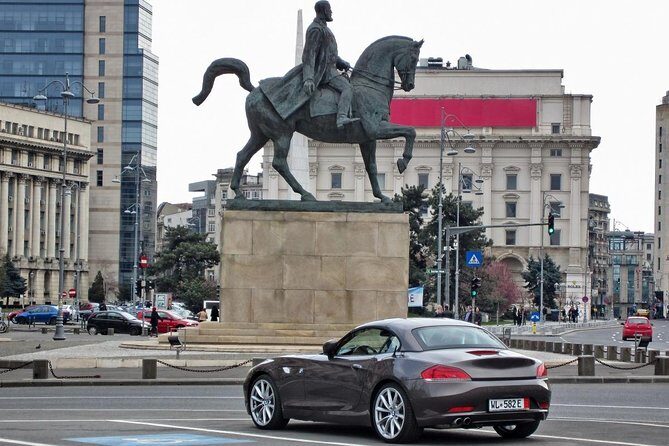
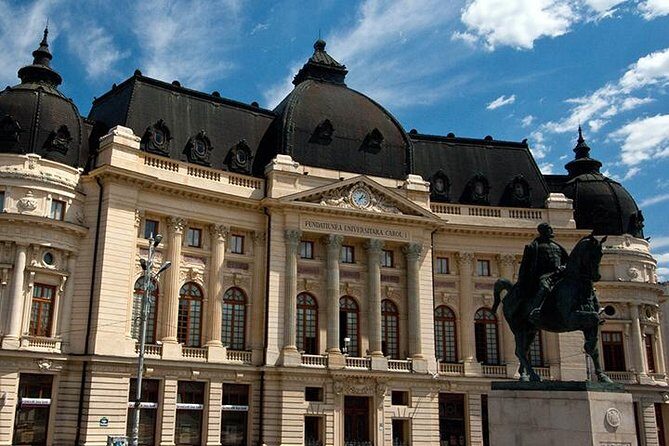
You’ll also hear about the former headquarters of the Communist party, the Monument of National Rebirth, King Carol the First’s equestrian statue, and the University library, among other reference points.
A practical note for your experience: this section is built for sightlines and context. The guide’s job here is to keep the story grounded so the names and sites don’t blur together.
Then you step to Memorial of Rebirth, a 25-meter structure commemorating the struggles and victims of the Romanian Revolution of Christmas 1989. The scale makes the moment feel bigger than a single photo, even if you take one.
Military Circle and Sărindar Fountains: Ending With Garden Views and Old Prestige
To close, the tour includes the Military Circle and Sărindar Fountains. These are described as having beautiful gardens and a stunning historical building, built for the people of Bucharest by the people of Bucharest, more than 100 years ago.
This ending works for you because it shifts from heavy history into a calmer visual space. You get garden time, fountain views, and a moment to process everything you’ve seen without another major “headline” landmark right on top of it.
What This Tour Teaches You About Bucharest Under the Cold War
You don’t just get a parade of “important buildings.” The tour ties them to what the city went through: how Ceaușescu’s dictatorship and the Cold War affected Bucharest’s public image and architecture.
If that’s your kind of travel, you’ll appreciate the cause-and-effect approach. Big spaces and massive civic structures aren’t random here. They’re tied to how power wanted Bucharest to look, who it was meant for, and what it tried to project.
At the same time, it’s smart to know that a few people felt the guide leaned into personal political views at times. If you prefer the facts with minimal commentary, you may want to set that expectation upfront.
Walking Smart for a 3-Hour Route (and Getting the Photos)
This is a walking tour, and it’s not pretend-walking. One review noted around 17,000+ steps even without a fast pace, which means you should dress for real movement.
Here’s how to make it easier:
- Wear comfortable shoes with support. You’ll be on city pavement for the full loop.
- Bring a bottle of water. Heat can be demanding.
- Plan for a lot of short stops. Many are around 5 minutes, so the guide’s timing matters for photos and orientation.
Also, this experience is described as requiring good weather. If rain or severe weather shows up, you might be offered a different date or a refund.
Price and Value: What $30.77 Buys You in Bucharest
At $30.77 per person for about three hours, this tour is priced for value if you want a guided “big picture” of central Bucharest without piecing it together yourself.
You’re not just paying for narration. You’re getting:
- Hotel pickup and drop-off included
- A mobile ticket
- An English-language guide
- A private tour format, meaning only your group participates
Private format matters in a city like Bucharest. You get more flexibility if your group has questions mid-walk, and you’re not stuck waiting while strangers ask unrelated stuff.
If you want to see the essentials fast—squares, major architecture, and the 1989 memorial sites—this price can feel like a bargain. If you only want museum interiors, you might find yourself wishing for more time off-street. But this tour’s strength is the walking story.
Should You Book the Guided Walking Tour of Historical Bucharest?
Book it if you want:
- A 3-hour overview of central Bucharest with clear context
- Strong photo stops around Piata Unirii, Palace of Parliament, and the Memorial of Rebirth area
- A guide who explains how political eras shaped what you see today
Skip it or choose a different style if:
- You don’t want your walk to include 20th-century political history as a major theme
- You prefer a slow, quiet stroll with minimal discussion
- You don’t feel comfortable with a lot of walking in a few hours
If you’re short on time and you want the city’s “why” as much as its “what,” this is a solid first pass through Bucharest.
FAQ
How long is the Guided Walking Tour of Historical Bucharest?
The tour lasts about 3 hours.
What does the tour cost?
The price is $30.77 per person.
Is hotel pickup included?
Yes. Hotel pickup and drop-off are included, with pickup outside the main entrance of Manuc’s Inn on Strada Franceză 62.
Is the tour in English?
Yes, it is offered in English.
Do I need tickets for the stops?
Some stops list admission ticket free. Many sights on the route are viewed from outside, so you likely won’t need to purchase separate tickets for every point.
Can I get a refund if plans change?
Yes. You can cancel for a full refund up to 24 hours in advance of the experience start time. If you cancel less than 24 hours before, the amount paid is not refunded.