Bucharest moves fast; this tuk-tuk keeps up. This 2-hour circuit is built for first-timers who want the big sights without a full day of walking, with hotel-area pickup and frequent stops for photos.
I love the convenience of being collected right from your downtown lodging, and I love how the tiny vehicle makes it easier to pause at landmarks instead of rushing past them. You might even get a guide like Claudio or Alin, both repeatedly praised for keeping the ride fun and explanations clear in English.
One consideration: the tuk-tuk can feel breezy in cold or windy weather, and some stops involve extra paid entry if you want to go inside.
In This Review
- Quick hit key points
- A 2-Hour Tuk-Tuk Snapshot You Can Actually Use
- Pickup and How the Tiny Vehicle Changes the Tour
- Stop-by-Stop: University Square to Arcul de Triumf
- The Scânteia Building and Calea Victoriei: Ideology to Style
- Romanian Athenaeum and Revolution Square: Art Meets Upheaval
- Royal Palace, CEC Palace, and the Road Toward Old Town
- Palace of Parliament and Unirii Square: The City’s Heavy Machinery
- Price and Value: What Your $54.44 Covers
- Weather, Traffic, and How to Make the Ride Feel Good
- Who This Tuk-Tuk Tour Is For (and Who Might Want Something Else)
- Should You Book This Buch Tuk City Tour?
- FAQ
- What’s the duration of the Bucharest tuk-tuk city tour?
- What is the price per person?
- Does the tour include pickup?
- Is the tour in English?
- Are admission tickets included?
- Is the tour private?
Quick hit key points
- Hotel pickup from downtown means less time figuring out meeting points and more time seeing Bucharest.
- Small tuk-tuk size helps you get outdoor photo moments near the sights.
- Private tour vibe: it’s just your group, so you can ask questions without feeling rushed.
- Communist-era to Royal-era contrast is baked into the route, not added later.
- Blankets, water, and Romanian sweets keep you comfortable and moving.
- Traffic is real in Bucharest, so expect a bit of stop-and-go while crossing busy areas.
A 2-Hour Tuk-Tuk Snapshot You Can Actually Use
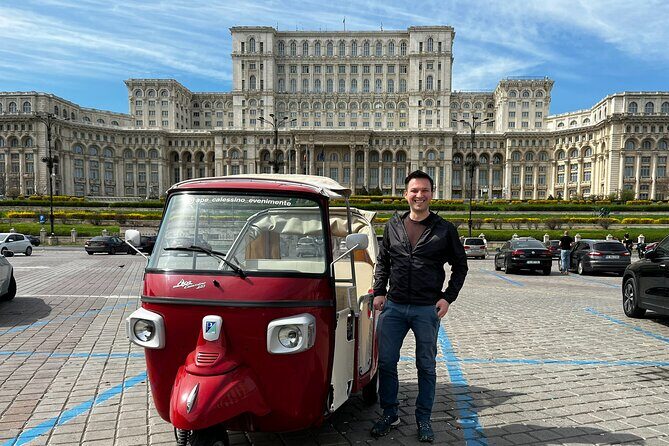
If you’ve got limited time in Bucharest, this tour is a practical way to get your bearings fast. In two hours, you’ll cover a chain of well-known landmarks that tell you how the city’s story shifted—from the look of the communist era, to royal Bucharest, to today’s street life.
What makes the experience work is the rhythm. You’re not trapped in a long bus ride with a single “photo stop.” Instead, you get short pauses at key points, plus enough context from your guide to help you connect what you see.
And yes, it’s fun. That small tuk-tuk silhouette draws attention on the sidewalk—like you’ve turned yourself into a moving postcard.
You can also read our reviews of more city tours in Bucharest


Pickup and How the Tiny Vehicle Changes the Tour

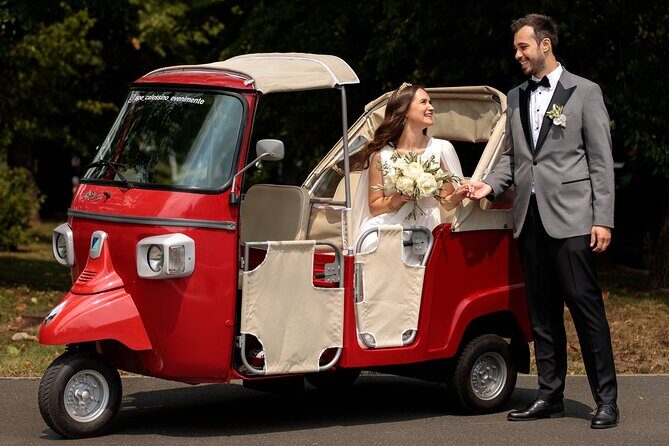
This is a private tour, and pickup is the main reason it feels easy. The guide waits in front of your hotel, and if the tuk-tuk can’t reach your exact door, they’ll meet you as close as possible and send the location on WhatsApp.
The tuk-tuk also changes the feel of “sightseeing.” Because it’s compact, it can pull near stops where cars and buses can struggle. That matters for you if you care about photos and street-level views, not just a drive-by.
The comfort details help too:
- Blankets for cooler days
- Bottled water and Romanian sweets
- A selfie stick (useful for group shots without dragging out your gear)
In cold or rainy conditions, the ride can still be chilly and windy. But the tour is clearly set up for weather reality, not perfect postcards. One review specifically praised how the guide adjusted when it was very cold, doing the tour in a warm car instead of staying fully exposed on the tuk-tuk.
Stop-by-Stop: University Square to Arcul de Triumf

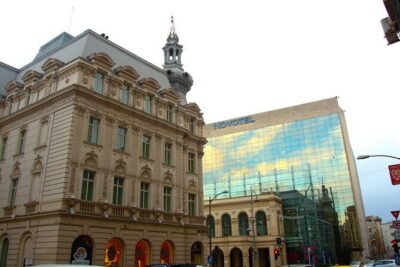
Your route kicks off around University Square, where you’ll take in big-city landmarks right away. Here you’ll see the National Theatre and the Grand Hotel Continental, noted as the city’s highest hotel. Even if you don’t go inside, these buildings set the stage: Bucharest can feel grand and European, and this is where you start to see that.
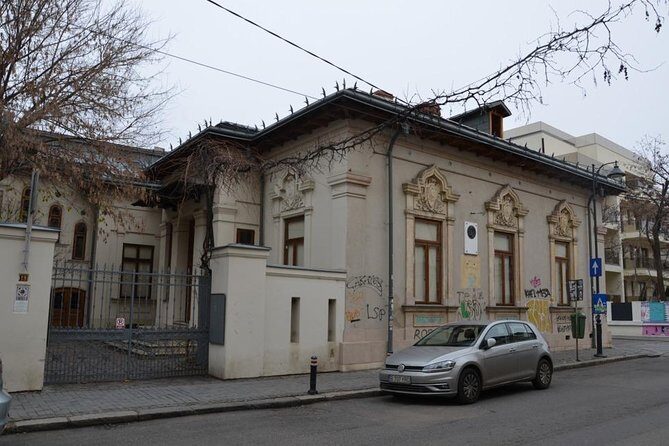
Next is Ceausescu Mansion—a name that instantly signals the political layer of the city. This is connected to major foreign state visits during the communist period, and today it operates as the Spring Palace museum (with entry at extra cost if you want to go in). It’s one of those stops where the guide’s storytelling matters, because the building’s purpose isn’t obvious just from its exterior.
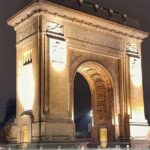
Then you reach Arcul de Triumf (Triumphal Arch). You’ll have time in a busy intersection area, which makes it feel very “Bucharest” rather than staged. The arch follows the French model, earning Bucharest a nickname of sorts for its Paris-like vibe in the past. You’ll likely appreciate that the stop is timed for quick outdoor photos and context from the guide rather than a long museum session.
A small practical note: the pricing details provided for this stop appear inconsistent—one part lists admission as free, while another lists a paid ticket. Plan for Arcul de Triumf as an exterior-and-photo moment, and if you want the interior, confirm what’s required on the day with your guide.
The Scânteia Building and Calea Victoriei: Ideology to Style
After the grander squares and monuments, the tour hits a very specific kind of Bucharest landmark: the building known for its connection to the communist-era publication Scânteia. After the Revolution, it became the House of the Free Press. This stop is a good reminder that Bucharest didn’t just change rulers—it changed labels, institutions, and the meaning of buildings.
Then comes Calea Victoriei, one of the city’s most famous streets and an older “main artery” for the area. It’s the aristocratic, storefront-and-history kind of street—fashion shops, art boutiques, coffee stops, and historical facades. If you want to understand modern Bucharest without wandering blindly, this street is a helpful anchor.
Why this part works: it adds texture. You’re not only seeing monuments; you’re seeing how the city looks when it’s living day-to-day. If you’re the type who later wants to return to a neighborhood on foot, this stop helps you pick where to go next.
Romanian Athenaeum and Revolution Square: Art Meets Upheaval
The Romanian Athenaeum is the next “wow” moment, and it’s not only about architecture. Opened in 1888, the building is known as one of Bucharest’s most prestigious concert halls and is tied to the George Enescu Philharmonic and the George Enescu Festival. Even if you keep it exterior-focused, it’s the kind of landmark that makes you pause because it feels ceremonial.
From there, the tour moves to Revolution Square, where Nicolae Ceaușescu delivered his last speech in 1989. This is where the city’s modern identity is tied to a single breaking point. It’s a short stop, so don’t expect a full lecture—but do expect your guide to connect why this square matters beyond dates.
If you’re trying to understand Bucharest in a hurry, these two stops in sequence help you feel the contrast: a place for music and culture, followed by the place where an era snapped.


Royal Palace, CEC Palace, and the Road Toward Old Town
Next you’ll see the Royal Palace of Bucharest, the winter royal residence built in 1937 with direct supervision from Queen Maria and her son, King Carol II. Again, it’s mostly a viewing and photo moment in this time window, not a deep interior visit. But that’s the point of a short tour—you get the structure and the location, then decide if you want to return.
Then comes Palatul CEC, another iconic structure. It’s tied to the oldest bank of Romania, and it gives you a sense of how finance and power have shaped Bucharest’s center.
Right across from Palatul CEC is the National History Museum of Romania, described as the biggest of its kind in the country and located at the entrance to Old Town. Even if you don’t go in during the tuk-tuk tour, this framing is useful. It tells you where the “serious museum street” begins.
If you like museums but hate decision fatigue, this is exactly the right kind of stop. You’ll know whether you’re excited to commit extra time to history after you see what’s nearby.
Palace of Parliament and Unirii Square: The City’s Heavy Machinery
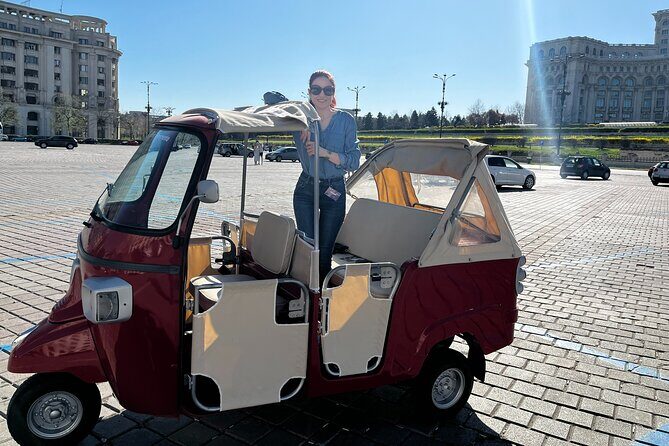
The Palace of Parliament is the kind of building you understand immediately is out of scale. You’ll get the headline detail: it’s the second largest administrative building in the world after the Pentagon, and it’s described as even heavier than it sounds. There’s also a comparison to the volume of the Great Pyramid of Giza, which is meant to help your brain wrap itself around sheer size.
This stop is short, but it’s memorable. Even without entry, you’ll see why it has become a symbol—part of how Bucharest expresses its political power in brick and stone.
Then the tour ends at Piața Unirii. Here you’ll have time at the famous fountain area where 44 fountains are synchronized into a choreographed display. The tour is timed for quick viewing rather than a long waiting session for a full show, but the fact that these fountains are described as the longest synchronized choreographic fountains system in the world is the kind of detail that makes your pictures make sense later.
Piața Unirii also matters because it’s a gateway to other parts of the city. It’s described as one of the best access points to Old Town and nearby attractions, so the tour isn’t just a loop—it’s a starting map.
Price and Value: What Your $54.44 Covers
The base price is $54.44 per person, and the time is about 2 hours. That’s a fair deal for what you get because you’re paying for more than transport. You’re paying for:
- Door-area pickup (less hassle than meeting at a distant plaza)
- A private group experience rather than squeezing in with strangers
- Guide interpretation so monuments mean something, fast
- Small vehicle flexibility for photo stops
- Comfort extras like water, sweets, and blankets
Now the part you should budget: interior admissions are not included. Several stops list entry as extra, including Ceausescu Mansion (€12), Royal Palace (€6), Romanian Athenaeum (€3), and National Museum of Romanian History (€5). If you decide to buy every listed paid ticket you can, that added total lands around €26 (not counting any tickets that might vary based on day-of rules).
So your value equation looks like this:
- If you stick mostly to exterior viewing and choose only one or two interiors, you’ll keep costs controlled.
- If you want to enter several buildings, plan for the extra euros, and remember that this is still a short tour. You can’t turn two hours into a full museum day.
Weather, Traffic, and How to Make the Ride Feel Good
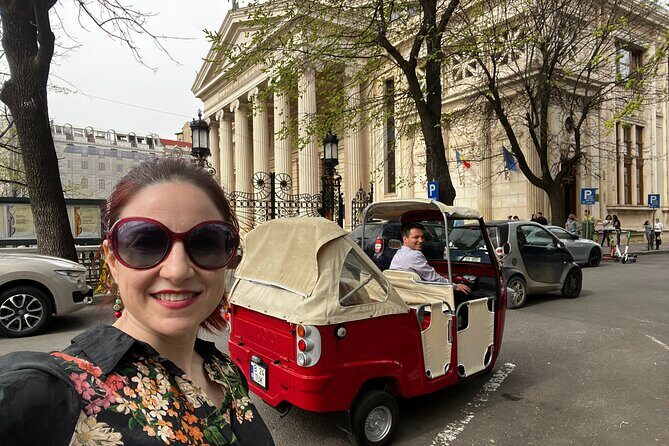
Bucharest can be windy, and tuk-tuks are small. That’s the trade. Even with blankets provided, you’ll feel air movement more than you would in a car.
The good news is that the tour is designed for real conditions. You’ll start with blankets, and you can expect your guide to keep things practical. One review praised an adjustment to a warm-car approach in cold weather, and another mentioned rain ponchos when conditions turned unpleasant.
Traffic is also worth acknowledging. Bucharest’s main intersections can be chaotic. Your driver needs to be confident, and multiple reviews praise that the driver stays calm and safe even when the streets get busy. Still, do expect stop-and-go moments—this is sightseeing, not an autopilot highway run.
If you want the most comfortable ride, dress in layers. Think windbreaker over a sweater, not a light T-shirt gamble.
Who This Tuk-Tuk Tour Is For (and Who Might Want Something Else)
This is a strong fit if:
- You’re visiting Bucharest for the first time and want the big picture quickly
- You prefer short stops you can photograph over long walking routes
- You like history, but you want it presented in a way that matches your time budget
- You’d rather sit while someone helps connect the city to context
It may be less ideal if:
- You want deep museum time, not quick exterior viewing
- You hate being out in the air on a small vehicle (even with blankets)
- You expect admissions to be included in the price for every stop
Should You Book This Buch Tuk City Tour?
Yes, if you want an efficient, fun introduction to Bucharest with hotel pickup, photo-friendly stops, and a route that moves through the city’s most important eras. The price feels reasonable because it’s built around guidance and convenience, not just riding around.
I’d book it especially if you plan to return later for a longer museum visit or a neighborhood walk. This tour doesn’t try to do everything; it helps you decide what’s worth your extra time.
If the weather is rough, go in prepared with layers, and ask your guide what they recommend for staying comfortable on the day. With the blankets and practical adjustments described, you’re not going to be left freezing with nothing to do.
FAQ
What’s the duration of the Bucharest tuk-tuk city tour?
The tour lasts about 2 hours.
What is the price per person?
The price is listed as $54.44 per person.
Does the tour include pickup?
Yes. The guide waits in front of your hotel or stops as close as possible if the car can’t reach your exact location, with the meeting point sent on WhatsApp.
Is the tour in English?
Yes. The tour is offered in English.
Are admission tickets included?
No. Several stops list admission as not included, with extra costs shown for places like Ceausescu’s Mansion, the Royal Palace, the Romanian Athenaeum, and the National History Museum.
Is the tour private?
Yes. It’s a private tour/activity, so only your group participates.