REVIEW · BUCHAREST
Tuk Tuk Bucharest Tour – Unique Experience in town!
Book on Viator →Operated by Tuk Tuk Bucharest Tours · Bookable on Viator
Bucharest clicks into focus from a tiny tuk tuk. This private ride gives you a fast, comfortable way to see Bucharest’s main landmarks while learning the stories behind them, without feeling stuck on a long walking route. Tuk tuk access also means you can get in close for photos and viewpoints that are hard to reach any other way.
I especially like the private-tour feel: it’s just your group, and the guide can shape the pace so you’re not rushed. I also like the photo-first planning, including stops where the tuk tuk can pull in close and linger for pictures, like the fountain area and under the Triumph Arch.
One watch-out: some big stops are outside-only, and a few key sites have admission tickets not included. Also, outdoor timing matters since the Bucharest fountains don’t run during winter due to frost risk.
In This Review
- Key reasons this tuk tuk tour works in Bucharest
- From Strada Doamnei to the big streets: why this starts near the Old Town
- Calea Victoriei: Bucharest’s oldest main artery, with easy photo stops
- Palatul CEC and the National History Museum: banking icon to museum gate
- Palace of Parliament outside: seeing the scale without burning half a day
- Bucharest fountains and Victoria Palace: choreographed water and government landmarks
- Dorobanti’s embassies and villas: the city looks different when you leave the main tourist axis
- Ceausescu Mansion: a quick courtyard stop with a heavy story
- Herastrau Park passes and the National Village Museum area
- Triumph Arch and Revolution Square: Bucharest’s political map in two stops
- Romanian Athenaeum photo stop: where classical concerts take place
- How long should you book: 1, 2, or 3 hours for your schedule
- Value for $72.56: where the money goes in this kind of tour
- Your guide makes the difference: what stood out with Valentin and Robert
- Weather and seasons: when the itinerary changes in real life
- Should you book the Tuk Tuk Bucharest Tour?
- FAQ
- Where is the meeting point for the Tuk Tuk Bucharest Tour?
- Is pickup available?
- How long is the tour?
- Is this tour private?
- Are museum or attraction tickets included?
- Do the Bucharest fountains run in winter?
Key reasons this tuk tuk tour works in Bucharest
- Pickup near the Old Town hub makes it easier to start without battling taxis first
- A tight sightseeing loop links major areas so you don’t burn your day in transit
- Photo-friendly stops where other vehicles can’t stop or can’t get the same angle
- Outside viewing of major landmarks (like the Palace of Parliament) saves major walking time
- A guide who can explain what you’re seeing as you move street to street
- Both “old town” icons and “new town” neighborhoods show different sides of the city
From Strada Doamnei to the big streets: why this starts near the Old Town
The meeting point is Strada Doamnei 8, right by the National Bank of Romania (next to the Hilton Garden Inn Old Town). If you’re staying downtown, you can also get free pickup from hotels and apartments in the area, which is a huge help if you arrive with luggage or you simply want the day to start smoothly.
This matters because Bucharest is spread out. Even when attractions are “close” on a map, streets can mean long walks and slow cross-city travel. A tuk tuk route fixes that fast by stacking landmarks into a short timeline.
And since the tour is private, you’re not waiting for the slowest person at every stop. You’re moving as a group, stopping when it’s worth stopping. That’s the difference between seeing Bucharest and just passing through it.
You can also read our reviews of more tours and experiences in Bucharest.

Calea Victoriei: Bucharest’s oldest main artery, with easy photo stops

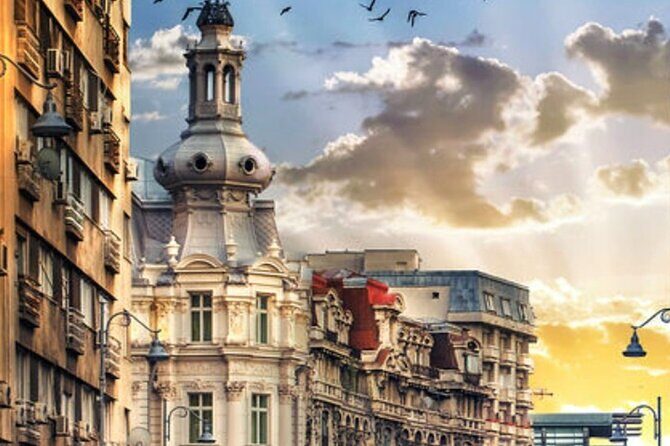
The first major stretch is Calea Victoriei, described as the city’s oldest artery and also its most touristic one. You ride the route and immediately get the city’s rhythm: grand facades, historic buildings, and street views that look different depending on the angle.
It’s set up as a relaxed introduction. The plan includes time to see historical buildings along the street and take photos in front of key sights, with short facts as you pass. One practical perk: you’ll get suggestions for where to spend more time later, which is great if you’re using this tour as your first-day orientation.
A small “do this your way” tip: if you like architecture, keep your phone/camera ready for the quick photo windows. This is not a museum stop. It’s a street-view course correction for what to prioritize when you’re walking later.
Palatul CEC and the National History Museum: banking icon to museum gate
Next you stop at Palatul CEC, an iconic building that houses Romania’s oldest bank. Even if you don’t go inside, the exterior is a classic Bucharest marker, and it sets a tone: this city likes its landmark buildings to do more than look pretty.
Across the way is the National Museum of Romanian History. You get a brief stop opposite the entrance area, right at the gateway into Bucharest’s Old Town. Admission for the museum itself is not included, so you’re using this stop for orientation and photos rather than a full visit.
For many people, this is the smartest use of time. If you try to do every museum on a tight schedule, your day turns into line-waiting. This approach helps you decide later what you actually want to see up close.
Palace of Parliament outside: seeing the scale without burning half a day
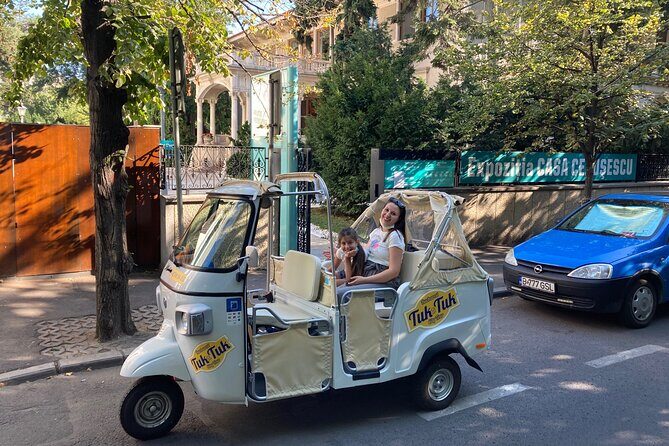
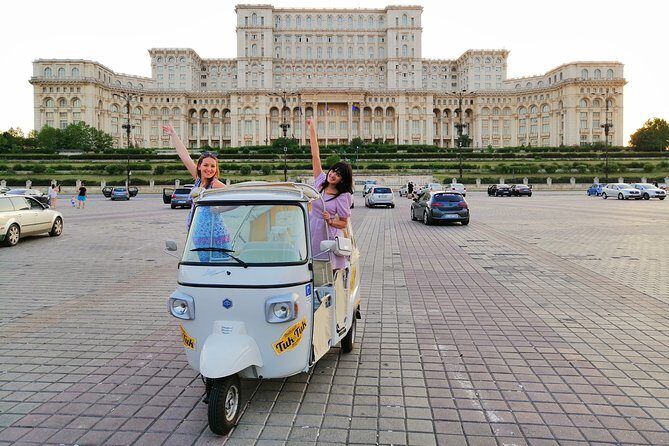
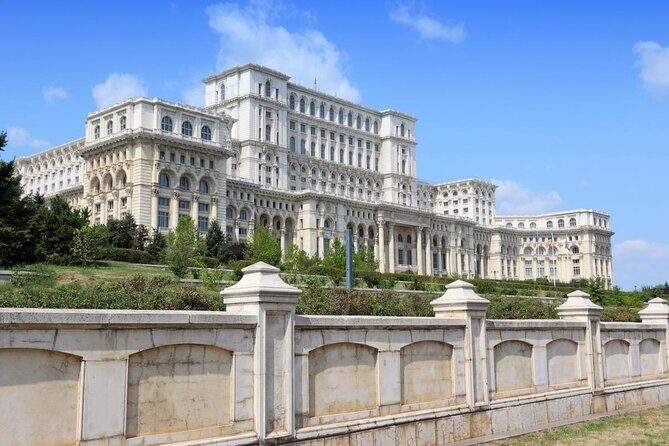
The biggest “wow” moment in the route is the Palace of Parliament. You’ll do a full outside tour by tuk tuk, with enough time for the best photo stop in front of the building in Constitution’s Square.
Here’s why the vehicle choice matters. The tour notes that walking around the building would take at least 30 minutes just to go around it. With the tuk tuk, you don’t waste that time shuffling position and backtracking—you’re free to focus on the scale.
The Palace of Parliament is described as the biggest building in Europe and the heaviest in the world. Even if you don’t care about those superlatives, the sheer mass hits you immediately from multiple angles. The route is planned so you see it from the most photogenic spots instead of only from one frontage.
Admission is not included, which keeps expectations clear. Think of this as a major exterior viewing plus photos, not a guided visit inside.
Bucharest fountains and Victoria Palace: choreographed water and government landmarks
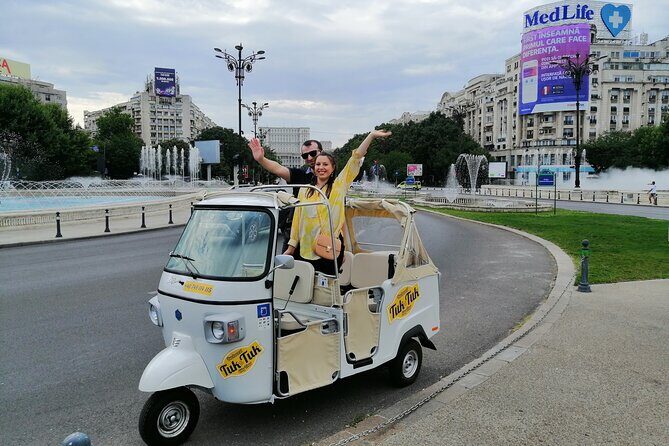
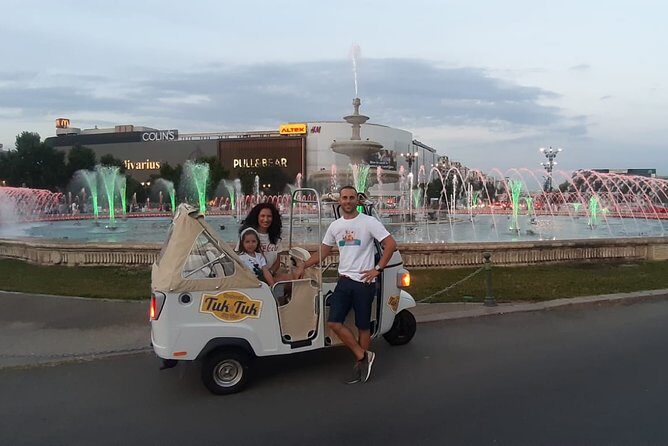
You continue to the Bucharest Fountains system, restored in 2018. The tour frames it as the longest synchronized choreographic fountain system in the world. That’s the headline, but the practical value is simpler: you stop next to the main fountain for pictures, in a place designed for viewing.
There’s one key seasonal note. During winter time, the fountains aren’t running due to frost danger. If your trip is in colder months, you’ll still get the surrounding viewpoint and photo stop, but don’t count on the water show part.
Then you reach the Victoria Palace, built between 1937 and 1944. It houses the Government of Romania and sits on Victory’s Square, alongside other notable sights like the Natural History Museum Grigore Antipa. You get a quick exterior stop here, free, so you can file it away as part of Bucharest’s political map.
This is a good stretch for people who like “context.” You’re moving from grand facades to state power to public space, and you can feel how Bucharest organizes itself around government and culture.


Dorobanti’s embassies and villas: the city looks different when you leave the main tourist axis
After those central landmarks, the route shifts into Dorobanti District—one of Bucharest’s more exclusive neighborhoods. You’ll ride through and around it, with embassies and impressive villas showing different architecture styles than the center.
This part is valuable because it breaks the “all photos, all monuments” loop. Dorobanti gives you the sense of where people live and how the city changes as you move out from the historic core. It also helps you picture day-to-day Bucharest, not just headline sights.
Even with only a short ride-time segment, you’ll pick up details that guide your later strolls: what streets feel residential, what areas look quieter, and how architecture changes blocks to blocks.
Ceausescu Mansion: a quick courtyard stop with a heavy story

You’ll stop near Ceausescu Mansion, recently opened to the public. This palace reveals the life of the last communist dictator’s family, and it’s located in one of Bucharest’s stronger residential areas.
This stop is short and focused on the exterior/courtyard photo moment. Admission is not included, so you’re not committing to a museum-style visit during this tuk tuk segment. Still, the courtyard access and photos help you connect the architecture to the politics behind it, which makes the bigger history easier to understand later if you decide to go in.
If this theme interests you, you’ll likely want more time in your overall schedule. If it doesn’t, you’ll still come away with a clearer picture of how Bucharest’s leadership eras shaped the built environment.
Herastrau Park passes and the National Village Museum area
Next is Parcul Herastaru, described as the biggest park in the city. You’ll pass by and get facts along the route, which is a nice change of pace after more “hardscape” landmarks.
The National Village Museum is in this area, with a noted opening date of 1936. It’s presented as one of the biggest museums of its kind in Europe, and it houses collections of medieval and modern Romanian art as well as international collections assembled by the Romanian royal family. The museum is also linked to the Royal House of Romania.
Because this is a tour ride-and-photo route, you’re not set up for a full museum visit here. Think of it as seeing where the story continues. If you want to spend real time inside, you’ll need a separate block later.
Still, even from a route view, Herastrau Park helps your overall Bucharest picture feel less compressed. You’ll start to see Bucharest as parks and culture, not just plazas and monuments.
Triumph Arch and Revolution Square: Bucharest’s political map in two stops
You get a key photo moment at Triumph Arch, known as Arcul de Triumf. It’s presented as Romania’s symbol of independence for more than 100 years. The tour highlights a practical advantage: there’s no other vehicle that can stop you beneath the Arch like a tuk tuk can.
That single detail changes your photos. From a normal street position, the Arch feels distant. From under it, the scale becomes the subject, and you can frame it with less “traffic noise” in the background.
Then you head to Revolution Square, named after the Romanian Revolution in 1989 against the communist regime. The stop is quick, free, and focused on seeing the square’s important buildings. This is another exterior-only moment, but it gives you the geography of modern Romanian political identity.
Together, Triumph Arch and Revolution Square help you connect different eras of power: independence, then revolution. Even if you know little beforehand, the tour’s sequencing makes the story easier to follow.
Romanian Athenaeum photo stop: where classical concerts take place
You also stop in front of the Romanian Athenaeum, described as an iconic building in the heart of Bucharest and a venue for classical music concerts. It was completed in 1881, and you stop right in front to capture the best photos.
This stop is brief, but it’s a useful reminder that Bucharest’s culture is not limited to palaces and squares. The Athenaeum belongs to the city’s musical identity, and the exterior photo stop helps you remember to look it up later if you want to match the building to performances during your stay.
If you’re into architecture or cultural landmarks, this is one of those “don’t rush” moments. Even a quick stop lets you see the building as more than a picture. You can also use it as a landmark when planning evening walks.
How long should you book: 1, 2, or 3 hours for your schedule
The duration runs from about 1 to 3 hours. In practice, the best length depends on how you want to use the tour.
A 1-hour version works well if you’re on a tight timeline or you’re arriving with only a little energy. You’ll get the core orientation and photo moments, but you’ll likely feel a bit “cut short” if you love architecture and want longer pauses.
A 2-hour tour usually hits the sweet spot for people doing a first pass through Bucharest. You get more time in the main areas, and the route feels like a guided overview instead of a rapid highlights reel.
If you can do 3 hours, it’s the best fit for slow photographers and history-curious travelers. You’ll have more room for extra questions while still keeping a packed plan.
One more practical point: the tour is on the small-and-personal side, and it’s private. That means your guide can adapt within the time window, which is why length matters so much.
Value for $72.56: where the money goes in this kind of tour
At $72.56 per person, this isn’t a budget “hop-on, hop-off” type of deal. The value comes from what you’re buying: time saved, distance covered, and access for photo angles.
The route links major landmarks spread across different parts of Bucharest, including central boulevards, government squares, a more residential neighborhood, and park-side areas. Doing that by foot would mean lots of backtracking and tired legs. Taking taxis alone can be faster, but you lose the structured stops, context, and the planned photo windows.
You also get pickup from downtown hotels/apartments (when you’re in the service area). That reduces friction on day one, which is worth money in a city that can feel complicated without a plan.
Finally, the tour includes group discounts and is sold as a private experience. If you’re traveling as a pair or small group, the per-person cost tends to feel more reasonable because you’re not paying for empty seats.
Your guide makes the difference: what stood out with Valentin and Robert
The big pattern in the experience is the guide’s personality and the way they handle questions. Guides like Valentin and Robert are repeatedly described as friendly, engaging, and proud to explain Bucharest past and present.
Two things really elevate the tour experience. First, they take your curiosity seriously, so you don’t feel like you’re stuck with a script. Second, they handle photos like part of the job: helping you get in shots together, not just taking pictures over your shoulder.
There’s also a practical “helpfulness” vibe that shows up in the feedback. In at least one case, the guide offered extra help at the end, including assisting with getting to a taxi. In another, the tour included small touches like water and snacks, plus help with a restaurant reservation.
Those details don’t just make the tour nicer. They make the rest of your Bucharest day smoother too.
Weather and seasons: when the itinerary changes in real life
This experience requires good weather. If it’s canceled due to poor weather, you should expect a different date or a refund.
Seasonal changes matter too. The fountains are noted as not running during winter due to frost risk. In summer, you might want to plan for warm conditions since the ride is open-air style, and comfort can depend on the weather.
A simple strategy: check your Bucharest forecast a day or two before. If your trip is in a shoulder season, consider booking a time window that’s more likely to be stable. That way, you get the best version of the route.
Should you book the Tuk Tuk Bucharest Tour?
Book it if you want a fast orientation and you’d rather spend your energy enjoying the city than hauling yourself between far-flung sights. It’s also a strong choice if you like architecture, photos, and a clear storyline moving from historic streets to political landmarks to park culture.
Skip it, or pair it with a different plan, if you expect a lot of interior museum time. Several notable places are outside-view photo stops, and admission tickets are not included for certain museums and sites. You’ll likely want separate time for deeper visits if those are your main goal.
If your schedule is tight, this tour is a smart first move. It helps you understand Bucharest’s layout fast, so the rest of your walking routes and restaurant picks feel more confident.
And with a private format, you get something simple but rare: a sightseeing plan that fits your group, not the other way around.
FAQ
Where is the meeting point for the Tuk Tuk Bucharest Tour?
The tour meets at Strada Doamnei 8, București 030167, Romania. It’s in front of the National Bank of Romania on Strada Doamnei 8, next to the Hilton Garden Inn Old Town Hotel.
Is pickup available?
Yes. Free pickup is offered from hotels or apartments located in the downtown area.
How long is the tour?
The tour lasts about 1 to 3 hours, depending on the option you book.
Is this tour private?
Yes. It’s a private tour/activity, and only your group participates.
Are museum or attraction tickets included?
Some stops are free photo stops, while certain sites specify that admission tickets are not included (for example, the National Museum of Romanian History, the Palace of Parliament interior is not part of the visit, and the Ceausescu Mansion stop).
Do the Bucharest fountains run in winter?
No. During winter time, the fountains are not running due to the danger of frost.